
Sermon Notes: Mark 3:13-21

Good morning! Today, we are going to do something a little different.
We are going to learn the most effective way to dig deeply into studying the Bible while we study our text.
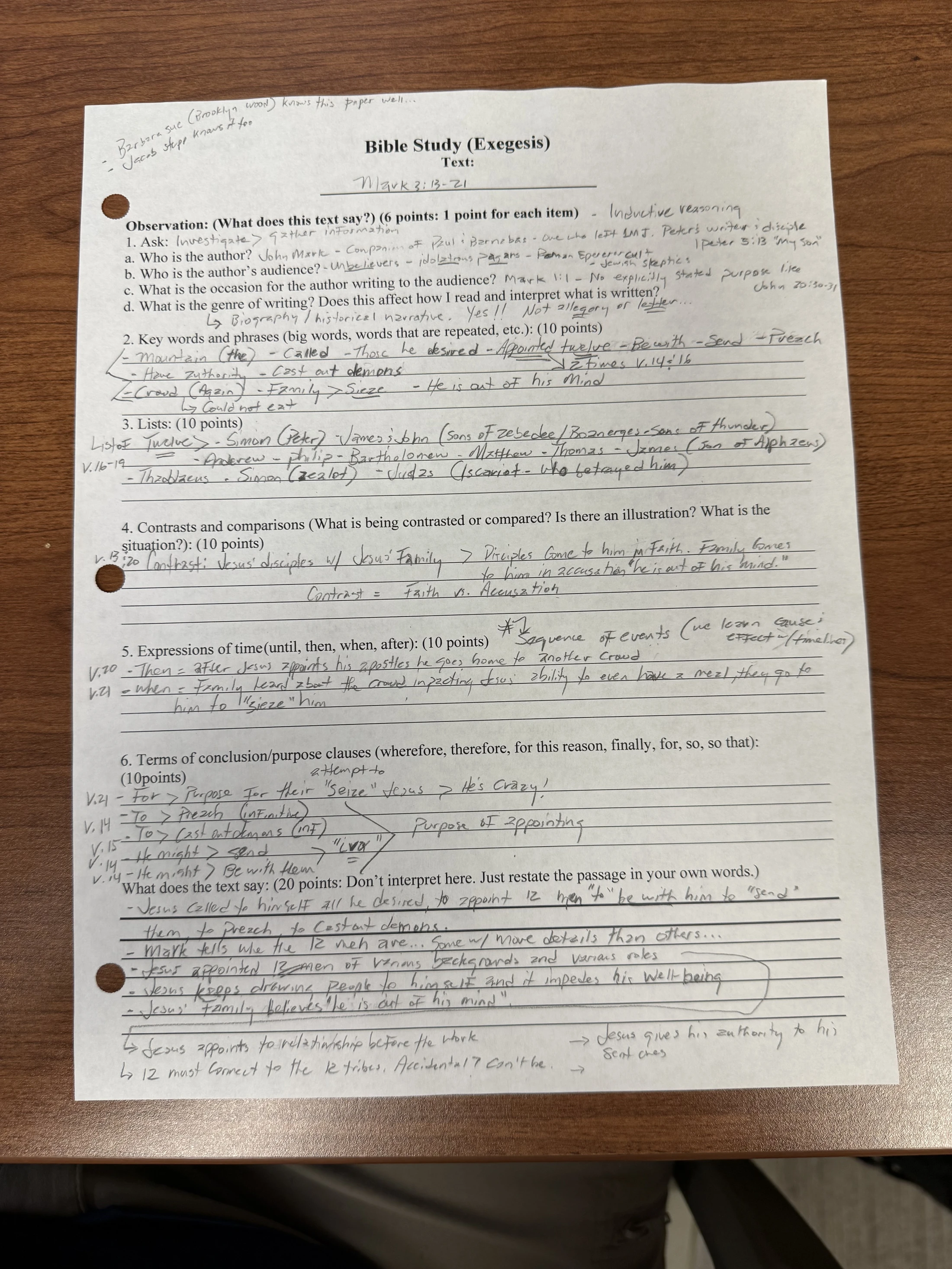
I do this every week as the process of constructing my manuscript. This is my default methodology, and usually I do in in Word, but pulled out my old worksheet from my teaching days.
This is how I create the bones of my manuscript. I've got the bones here, and I'm going to leave it to you to go put some meat on those bones after this morning.
I will post a manuscript of this morning tomorrow so you can use our time together more later by going back and reading what I said this morning that is no on the document I posted below.
Mark 3:13–21
Observations: What Does the Text Say?
The first task in inductive Bible study is careful observation—asking what the text actually says before moving to interpretation or application.
Author
John Mark, companion of Paul and Barnabas on the first missionary journey (Acts 13), later became a disciple of Peter, serving as his scribe and literary associate. The same Mark whom Paul once dismissed (Acts 15:37–39) is later called “useful in the ministry” (2 Tim. 4:11)—a testimony to the grace of God and the mentorship of Barnabas (“Son of Encouragement,” Acts 4:36).
Audience
Mark writes not to believers but to unbelievers: idolatrous pagans, adherents of the Roman imperial cult, and Jewish skeptics. This Gospel functions as a compressed, historically grounded narrative of Jesus’ life—a field manual for proclaiming Christ to those who do not yet believe.
Purpose and Genre
Mark states his purpose implicitly in 1:1: “The beginning of the gospel of Jesus Christ, the Son of God.” This is biographical-historical narrative. It is not allegory, not epistle, not apocalyptic literature. It is eyewitness-grounded biography written with evangelistic intent. Mark believes what he writes—the resurrection has convinced him that Jesus is the Son of God, and he wants his readers to believe it too.
Key Words and Phrases
• The Mountain (v. 13): Not “a” mountain but “the” mountain—a definite article marking a specific, significant place in Galilee, likely associated with other mountain episodes in Mark’s narrative (the Sermon on the Mount, the Transfiguration).
• Called / Those He Desired (v. 13): Jesus calls selectively—those he desired. This is sovereign, intentional calling.
• Appointed (vv. 14, 16): The verb appears twice, emphasizing the deliberate, formal nature of this commissioning.
• Be With Him (v. 14): The primary purpose of the calling is proximity to Jesus. Discipleship is nearness.
• Send / Preach / Authority / Cast Out Demons (vv. 14–15): The sequence is intentional: nearness leads to sending, sending leads to proclamation, proclamation is backed by divine authority over evil.
• Seize / Out of His Mind (v. 21): Strong, legal-sounding language. His family’s mission is not to help him but to restrain him. Their diagnosis: insanity.
Contrasts and Comparisons
The passage sets two responses to Jesus in sharp relief. The crowds and the Twelve come to him; his own family moves away from him. Those he calls respond in faith and follow. Those nearest him respond with accusation and gossip. The contrast is faith versus accusation—or, put differently, relationship versus slander. The same Jesus who draws multitudes to himself is dismissed by his own household as mentally unstable.
Expressions of Time and Cause and Effect
Mark employs “then” (v. 20) and “when” (v. 21) to establish sequence and causation. After Jesus appoints the Twelve, he goes home—and the crowd follows him there. When his family hears of it, they respond by going to seize him. The cause: Jesus is the Son of God, drawing people to himself with irresistible force. The effect: the crowds multiply and his family concludes he has lost his mind. These are not incidental conjunctions; they are the literary architecture of cause and effect.
Purpose Clauses
The purpose clauses in this passage carry enormous theological weight:
• He appointed them so that they might be with him (v. 14)
• He appointed them so that he might send them out to preach (v. 14)
• He appointed them to have authority to cast out demons (v. 15)
• His family went to seize him for they were saying, ‘He is out of his mind’ (v. 21)
The divine pattern is unmistakable: be called → be with him → be sent → preach → exercise authority over evil. This is not unique to the Twelve—it is the pattern of God’s redemptive mission throughout all of Scripture.
Interpretation: What Does the Text Mean?
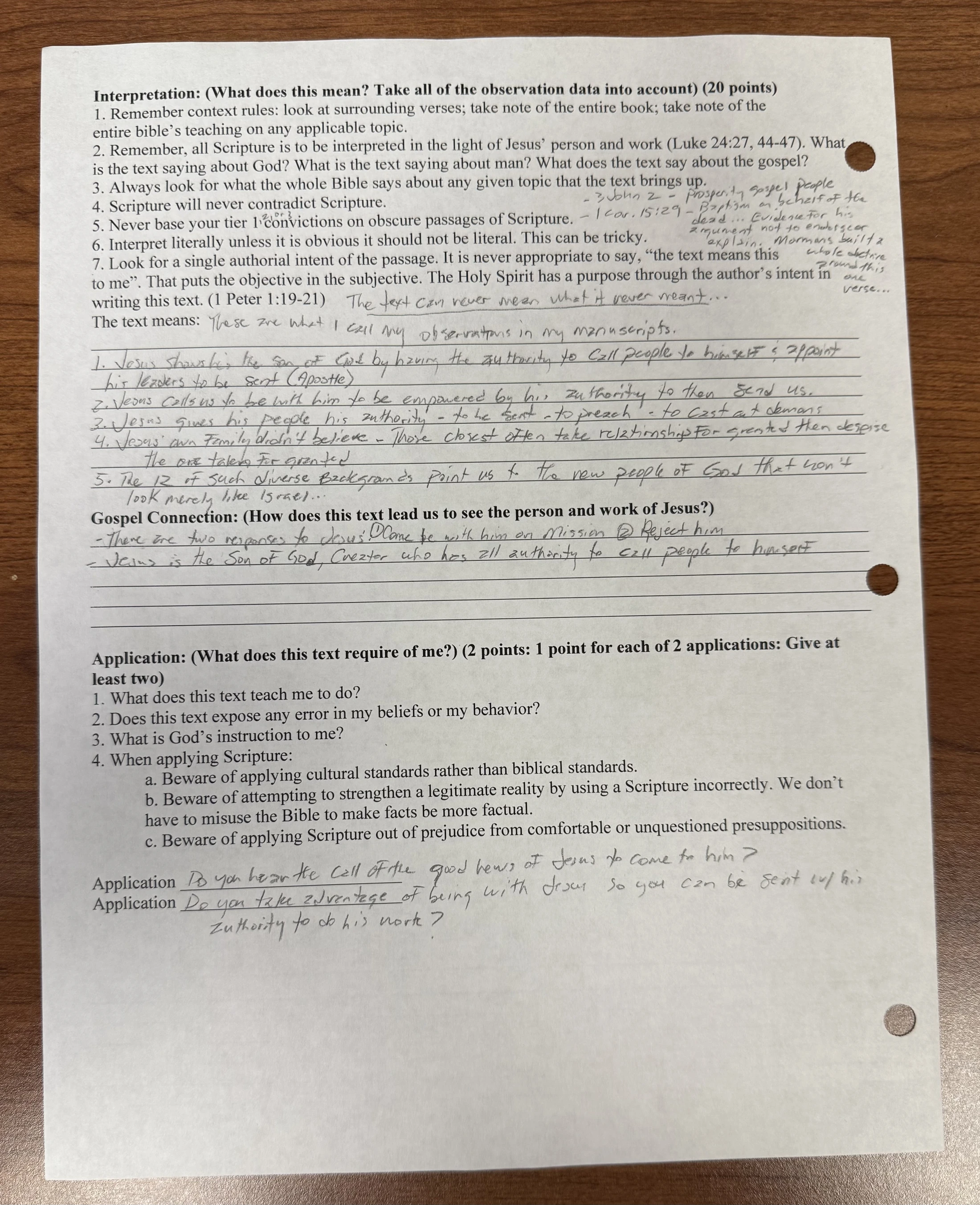
Interpretation seeks the single authorial intent of the passage. The question is not “what does this mean to me?”—that relocates authority from the text to the reader. The question is: what did the Holy Spirit intend through this author, in this context, for this audience? Rules for sound interpretation include: reading in context (immediate, book-wide, and canonical), allowing Scripture to interpret Scripture, refusing to build major doctrine on obscure passages, and reading literally unless the genre clearly signals otherwise.
1. Jesus Demonstrates His Identity as the Son of God Through Sovereign Authority
Jesus does not ask, negotiate, or campaign. He calls whom he desires, and they come. He appoints twelve, and it is done. This is the authority of the Son of God—the same authority that speaks creation into being, that commands the wind and sea. Mark’s evangelistic purpose is already at work: the reader is meant to see that this man operates with divine prerogative.
2. Jesus Calls People to Himself Before He Sends Them
The order matters profoundly. The call to “be with him” precedes the commission to preach and exercise authority. Mission without proximity produces burnout, moralism, and activism untethered from the living Christ. The pattern here is not pragmatic efficiency—it is theological necessity. You cannot be sent well by the one you do not know well. This text is a rebuke to every version of Christianity that rushes past the “be with him” to get to the “send.”
3. Jesus Grants His Authority to Those He Sends
The apostles do not manufacture their own authority. It is given. The word “apostle” (Greek: ‘apostolos’) means “sent one.” These twelve are not an ecclesiastical hierarchy—they are prototypes of the sent people of God, models of what Spirit-empowered mission looks like. Their authority over demonic forces is not intrinsic to them; it derives entirely from the one who appointed them. This has direct implications for how the church understands its own authority in proclamation and spiritual warfare.
4. Jesus’ Own Family Did Not Believe
This is among the most sobering details in the passage. Mary witnessed the annunciation. She bore the Son of God in her womb. She “took note of all these things and pondered them in her heart” (Luke 2:19). And yet here she stands, apparently persuaded by the whispers of siblings who have concluded that Jesus is mentally unstable. Familiarity breeds not only contempt but spiritual blindness. The people nearest to Jesus—those with the most access, the most history, the most evidence—are the ones moving away from him while strangers run toward him.
This is not merely a historical curiosity. The local church is perpetually in danger of doing to one another what Jesus’ family did to him: taking the grace of proximity for granted, substituting critique and gossip for faith and commitment. “Death and life are in the power of the tongue” (Prov. 18:21). When we assassinate one another with our words, we are participating in the same spiritual dynamic Mark exposes here.
5. The Twelve Point to the New Covenant People of God
Jesus did not appoint eleven or thirteen. He appointed twelve—a number freighted with Old Testament significance. The twelve tribes of Israel are being reconstituted around a new center: not ethnic descent but allegiance to the Son of God. The church is not merely a continuation of Israel—it is the eschatological fulfillment of it, comprised of Jew and Gentile, slave and free, all united in Christ (Gal. 3:28). The diversity of backgrounds among the Twelve—fishermen, a tax collector, a zealot, a betrayer—is itself a preview of the breadth of the new humanity Christ is forming.
Gospel Connection
There are two and only two responses to Jesus in this passage. Some come to him; others move away from him. Jesus himself taught, “Whoever is not with me is against me, and whoever does not gather with me scatters” (Matt. 12:30). There is no neutral ground. Mark is writing to pagans and skeptics, and his text demands a verdict.
Jesus is the Son of God—the Creator taking on flesh, the eternal Logos who walked with Abraham (Gen. 18), the Commander of the LORD’s army before whom Joshua fell on his face in worship (Josh. 5:14). He is not the God of the New Testament versus some other God of the Old Testament. He is the same God—Father, Son, and Holy Spirit—who has been calling a people to himself throughout all of redemptive history, and who is calling still.
If you have never believed the good news, the call comes to you now: come to him. The sending and the mission come later. The first call is simply to come near. And if you know him, he is calling you into deeper proximity—not because the journey is comfortable, but because the closer we draw to the Holy God, the more clearly we see ourselves, and the more fully we are transformed.
Application
Application asks: what does this text require of me? Where does it expose error in my beliefs or behavior? What is God’s instruction?
1. Do you hear the call of Jesus to come to him? The gospel is not primarily a set of propositions to be affirmed but a person to be received. He calls. Will you come? If you have never responded to him, today is the day.
2. Are you taking advantage of being with Jesus before you try to serve him? He has made a way to draw near. Are you drawing near—through his Word, through prayer, through the gathered community of his people? The authority to do his work flows from the intimacy of being with him.
3. Where have you been speaking death rather than life? The family of Jesus took proximity for granted and turned their words against him. The church does this to itself constantly. Examine your speech. Repent where needed. Commit to building up rather than tearing down (Eph. 4:29).
Prayer
Lord Jesus, thank you for calling us to yourself. “Come to me, all who are weary and heavy laden, and I will give you rest. Take my yoke upon you and learn from me, for I am gentle and lowly in heart, and you will find rest for your souls” (Matt. 11:28–29). Help us not merely to study your Word but to meet you in it—for you are its center, its purpose, and its end. Amen.
Psalm 119:105 — “Your word is a lamp to my feet and a light to my path.”